Simple musings, thoughts and ideas on educational technology, tech integration in the classroom and tech coaching . . . from my journey as a tech coach, computer science teacher and international educator.
Showing posts with label team building. Show all posts

Thursday, January 26, 2017

Can Shared Leadership Really Work?

Note - this post was originally written back in June (over 6 months ago, so all references to dates are for the 2015-16 school year) but never was published for a variety of complex and personal reasons which I won't get into here . . . but I found the text in my notes and thought it needs to be published.  So here goes, with a few small tweaks and updates . . .

This year, I became a "director" for the first time in my career. Now that the school year is almost finished, I would have to say that this social experiment in shared school leadership is partially successful and partially a failure. Just to back up for a moment, the school director had no intent to explore shared leadership for educational technology - he wanted to either continue with the traditional leadership structure with a Tech Director, or split off educational technology from technology services and support.  In discussing this latter option and what that would look like, I was asked to draft a job description for an Ed Tech Director. Some of you reading this now will remember me asking for copies of your job descriptions and a structural breakdown of technology at your school (BTW - everything that I collected from you back in the fall was greatly appreciated).  As the job description started to take shape, it became apparent that out of our team of 4 tech coaches, more than one of us would be interested in the director of ed tech position. With the potential for terminal discord and a fracturing of our working relationship as a team, we jointly decided to propose a shared leadership model.

After about a month of planning how we would work together to co-lead educational technology across the school, the four of us (tech coaches) were appointed to be Co-Directors of Digital Learning. Our proposal separated ed tech from tech services, and a new person would be hired to manage and lead IT which includes hardware, infrastructure and tech support. The four tech coaches (2x ES, 1x MS and 1x HS) would have dual roles supporting tech integration in our school division (or assigned grades), plus collectively leading educational technology across the school.  

With shared leadership - is everyone looking/moving in the same direction?  Is there a clear, shared and articulated vision?


We have been working with this model since about November of this school year, and I have really mixed feelings about how successful it has been.  In general, we have been able to move forward with a number of initiatives and projects which probably would not have happened or have progressed as far in a short time if we had stuck with a traditional Tech Director model. As there are four of us Co-Directors, we could divide up the work and push forward with projects which interested us or were important to us. For example, some of the bigger projects that I led were:
  • promoting and organizing the third annual Hour of Code, which featured events spread across the entire school
  • formally adopting the ISTE Standards for Students (through embedding the standards in our PYP and MYP planners), Teachers (currently working on adding the standards into our new teacher appraisal process), Coaches (which we adopted as tech coaches a few years ago) and Administrators (which we adopted as Co-Directors of Digital Learning)
  • writing and formalizing our job descriptions as tech coaches and as Co-Directors, to make them into usable documents which accurately describe both of these roles and what they truly entail
  • bringing Learning2Europe to Warsaw, taking on the role of conference chair and forming a team of teachers and staff who will form the core of the organizing committee and support team 
  • initiating an exploration and testing of Google Expeditions Beta along with Google Cardboard for use in the classroom
  • proposing a new project to put iPad Pro's into the hands of teachers (as an interactive whiteboard replacement and to facilitate teachers being able to annotate, comment, sketch/draw/graph on the fly in class) through a two stage approval program


So what were the challenges and problematic areas?

1) With a group of four individuals who are given "carte blanche" to initiate new ed tech projects, there is no single decision maker to say whether it is the right time and/or place to start each project, or to oversee how it all fits into the overall vision for the school. As a result, what we end up with is a collection of projects all in various stages of development, which may be disjointed, out of alignment and sometimes even at odds with each other. Without a single decision maker, everything moves forward on their own pathways, but sometimes in different directions.  

With shared leadership - are everyone's views of a similar hue, or completely different colours?


2) How well the group functions together really depends on the different personalities involved, their individual styles, and how well they mesh together. Any friction or lack of trust creates disharmony in the group and the team breaks down immediately. We all know how hard it is to regain trust once it is lost, and how quickly trust can disappear entirely. Given #1 above, trust will always be eroded as friction builds from differing opinions on direction and vision. Conflict will also come from the simplest of things, like how the group interacts with each other, talks to one another, and is inclusive or exclusive. In fact, the team started off with a feeling is distrust due to how we came to even brooch the subject of shared leadership. As the school director favoured a business approach to leadership, he pitted the four of us "against" one another and was looking to appoint one of us to the director role. This approach forced us all into feeling distrust for one another, which we had to address as a team before anything productive could be done as a group. 

3) Following on from #2 above, I think that the current school organization with two coaches in the ES, but only one each in the MS and HS created an imbalance, as two of the Co-Directors work very closely together and tend to have a unified position on any issue. Not that this is a bad thing - having at least part of the group working closely together is better than not having any of the group at all.  However, this made making decisions about the whole school difficult with four "votes" in total, but an internal coalition of two in place. This last point is key if shared leadership is to work smoothly. Instead of having each member of the shared leadership team be all things to their constituency (their school division), they should all represent the entire community at all times. Or perhaps it could be divided up by school division, but in a more balanced way such as two for elementary and two for the secondary school.  

Epilogue on this last point - this re-organisation of the tech coaches has actually happened for this school year, but not for the co-directors role (I think the school just kept three co-directors now that I have moved on and changed schools).  I think shared leadership would have a better chance of succeeding with a smaller group than 4.  I can think of many dual partnerships which were spectacular (Lennon and McCartney, Jobs and Wozniak . . . you can add to the list), but it becomes harder to think of some great examples of groups of 3 or 4.  Too many chiefs or chefs in the kitchen perhaps? 


In retrospect, I am happy to have had the opportunity to work in a shared leadership environment as it provided a unique learning experience and collaborative work at the highest levels. If another shared leadership opportunity comes up in the future then I will be better prepared and so much wiser about what the pitfalls are and try to address them up front.  Can it work productively and smoothly?  I am sure that it can, and I wonder if it is happening anywhere out there?  Have you ever worked in a shared leadership role? Did it/Does it work? What was your experience like?  What were/are the challenges?

Wednesday, September 23, 2015

Coaching with Mindsets in Mind - Big Takeaways for the Start of a New School Year

Big Takeaways for the Start of a New School Year

Well, the new school year has already gotten underway, but it seems that I am just now coming out of the fog and swirl of activity from the "boom" that marks the first day of classes.  With fall trips behind us, laptop rollouts and MAP testing done and dusted, and classes finally settling into a rhythm, it is time to reflect upon coaching from last year with an eye towards the future . . .


Here are my takeaways and thoughts/extensions for each:

  • From my end of year coaching survey, I believe that you can have someone who is a capable or even advanced user/facilitator/integrator of technology in the classroom, who is still in a Fixed Mindset when it comes to educational technology.  They are using/integrating a number of technologies effectively in their classroom, but are very comfortable with what tools they employ and are not open to looking at or experimenting with new tools.  With the train analogy from an earlier post - they are in the lead car but are doing nothing to help move the train forward as a whole, or to lead those in the front of the middle car into the lead car.  They remain siloed and comfortable in what they are doing in their classroom.  Sidebar - this is where the train analogy starts to break down, as the cars represent where a teacher is on the ed tech scale of integration, rather than incorporating their mindset as well (which is perhaps, more important).  So what's the way forward?  Screening for mindset and nudging these types of faculty forward into a Growth mindset through conversations and exposure to new tools which can be specifically employed in their classroom/subject area/discipline can help to shift them into a more collaborative and open stance.  These faculty members might be shifted through an individual conversation or through a conversation with a peer or in their own Personal Learning Network (PLN).  Or perhaps the shift will occur through some "just in time" training that comes up, or through exposure to a new tool or idea during a PD workshop, conference or Speed-Geeking session.  It's hard to identify when or where a shift in mindset will occur with these folks, but seize the opportunity when it arises and turn these folks into teacher-leaders with ed tech.
  • Again, from my end of year coaching survey, there are some faculty members who take a passive role when it comes to coaching.  Their stance is that they do not have time to consider new tools or to connect with other teachers in their discipline.  They expect everything to be brought to them for their consumption/consideration where they will passively decide whether it is something worth their time (usually not, or it will be "deferred" until a later time). These faculty members do not engage in the coaching process, are not very self-reflective and are therefore in a Fixed mindset.  They are notoriously hard to reach and to work with, as they would truly rather ignore you as a coach, then actually engage with you to improve teaching and learning.  These folks need to be nudged into a Growth Mindset to engage in the coaching process, which is hard to do.  If they are part of a team (teach a shared course, or are part of a grade level or subject team), then perhaps reaching this particular faculty member is best done through the team.  If their team decides to move forward with a new tool or approach, then they will have to follow along.  The toughest "nut to crack" is the stand-alone teacher who does their own thing and does not really belong to a team (they typically teach all stand-alone classes).  So how do you reach them?  By engaging them in conversation about their classes at every opportunity that presents itself, and by exposing them to new tools along the way.  The Walk-through/Check-ins that I regularly conduct also help with reaching these teachers, as it brings coaching and the conversation directly to them individually and personally.  All of these points of contact will help to nudge them forward, some faster than others of course.
  • Working directly with a team of Growth Minded faculty has been very fulfilling professionally for me, as well as for members of the group/team.  This is what I do with the HS Tech Collective, which has grown out of what started as a decision making tech committee, into a collaborative think tank for professional sharing around educational technology.  It is not composed of the most technologically adept or switched on faculty.  The group composition changes each year (there is one only member who goes back to the first year committee, and another who has drifted in and out of the group over the years) and they self-nominate/apply to join the Collective.  The short application acts to screen for mindset, rather than looking at their tech skills or abilities.  By focusing on what people want to learn about and experiment with in their own classrooms, I look for people who are expressly not experts in a particular tool, but are Growth minded towards trying something new and different that they are interested in.  These faculty members have already reflected on their own teaching practice and have self-identified their own need or gap or problem of practice that they want to work on.  Bringing Growth Minded faculty members together around ed tech, to share, collaborate and simply converse with no meeting agenda is transformational for everyone involved, which in turn gets spread back to their departments or co-teachers of shared courses.  Working with and developing the Tech Collective each year has been a game-changer for me as a coach, and is influencing the overall culture of the school as it matures and spreads.  So my takeaway here is simple - keep the Tech Collective going, moving forward, developing and changing the school culture in positive ways.


Tuesday, August 18, 2015

Coaching with Mindsets in Mind - Part 4

One more story from "On Court"

Now that the school year is finished and I am thinking about the highlights, this past spring season coaching the Varsity Girls Tennis Team stands out in my mind.  Just like in my previous post (Part 3), I can't help but apply my learning about Mindsets to our season, and think about how it relates to by role as a Tech Coach.  Some of what I have been thinking about also stems from reading one of my player's CAS reflections after the season, and her takeaways from playing on the team this year, compared to previous ones.

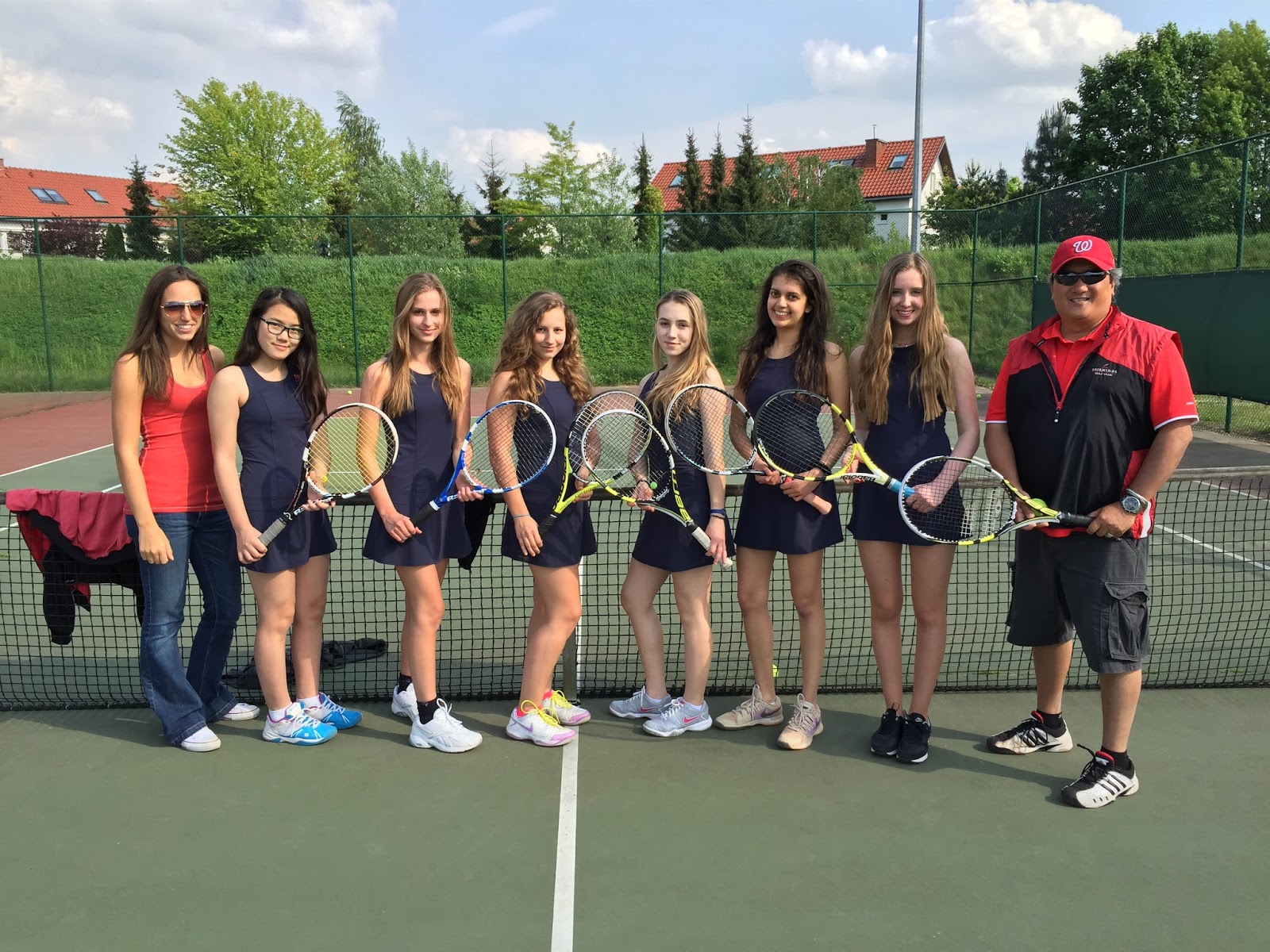
This year, I had the opportunity to shift over to being the Head Coach for the Varsity Girls when the long-time coach stepped down.  I have not worked with the girls team before, so we started the season with a team meeting so I could get to know the players who were trying out, and so we could talk about what they wanted to set as goals for the season.  It was a long conversation, but the girls had a central theme running through everything - they wanted to feel like a team, look like a team, and act like a team.  Part of this feeling came from last year where they went to the one and only tournament without proper uniforms, and played in boys soccer jerseys which were big, baggy and had numbers on the back.  Very unladylike and not inspiring at all.  At the end of that initial team meeting, we agreed on a few things which included: having proper uniforms, building our team spirit and identity, and supporting each other on and off the court.  This was perfect for me, as these are all things which I try to instill in the sports teams that I coach.  Little did I know that it would lead to endless hours of searching online for women's tennis dresses both locally and abroad, which would eventually impact the cookies on my laptop so that now all of the Google Ads and FB side panels are filled with pictures of the latest tennis dresses . . . ugghhhh!

ASW Varsity Girls Tennis Team 2015 - they wanted tennis dresses to look like a team, so we got them!

Fast forward to the end of the season and the CEESA HS Girls Tennis Tournament which we hosted here in Warsaw.  We had students, parents, teachers, and even some Board members and the new Director drop by to watch some tennis and see how it was going.  I think this was significant as we hosted the tournament off campus at a private tennis club, so people had to trek across town to see them play.  And they played fantastically, winning 3 of the 4 individual events plus taking the CEESA Team Championship for the first time in 6 years.  

Now, you might think that getting tennis dresses for the girls is insignificant but it wasn't - it was huge!  The other coaches and players at the tournament all commented on how great they looked on the first day.  My girls were all talking about how they felt like a team for the first time in years - it was all about the dresses (BTW - no other teams were wearing tennis dresses or even proper women's tennis clothing, and some coaches lamented that they could never get their girls into dresses, let alone skirts - we had a new outfit for day 2 ;-).  

CEESA Varsity Girls Tennis Champions 2015 - sporting their day 2 attire of hot pink tops with black skirts!

When the tournament was over and we were wrapping up the season, the girls talked about a number of things which made it very special for them.  I was surprised at what they came up with too.  They were happy about winning the championship of course, but it was all of the other stuff which stuck in their minds.  It was the team spirit that we had cultivated through the practices and out on display at the tournament that stuck with them.  From team warm-ups, to wearing uniforms, to team meetings, to doing team cheers (nobody does that in tennis, but I do), to supporting one another on and off the court.  One of my players even reflected on how "together" we are as a team even though it is a mainly individual sport, which she has never felt before in 5 years of playing on the school tennis team.  The same player also commented on how much she grew and improved this year, both with her skill level but more importantly with the mental part of the game.  What she wrote about was how her mindset changed over the season, and how looking back, it made all of the difference when she was on court at the tournament.

So what did I learn from this, and how does it apply to being a tech coach?  It all has to do with team building.  Building an effective team has to be an intentional process, and the little things count.  Details matter, having common goals and listening to your team is important - done right, this is how you can shift everyone into a Growth Mindset, to bring them together as a group.  Having a growth minded team working together and challenging one another, can lead to great achievements and breakthroughs - sometimes far beyond expectations.  I am really proud of the girls and what they achieved on court, but even more so with how they came together as a team and what they learned about themselves.  One of my players summed it up in her CAS reflection, with something I was constantly saying throughout the tournament - "One point at a time."  She really has taken this to heart, meaning to never give up, learn from your mistakes, and look to the future for the next opportunity . . . all sure signs of the Growth Mindset.