Simple musings, thoughts and ideas on educational technology, tech integration in the classroom and tech coaching . . . from my journey as a tech coach, computer science teacher and international educator.

Tuesday, August 18, 2015

Coaching with Mindsets in Mind - Part 4

One more story from "On Court"

Now that the school year is finished and I am thinking about the highlights, this past spring season coaching the Varsity Girls Tennis Team stands out in my mind.  Just like in my previous post (Part 3), I can't help but apply my learning about Mindsets to our season, and think about how it relates to by role as a Tech Coach.  Some of what I have been thinking about also stems from reading one of my player's CAS reflections after the season, and her takeaways from playing on the team this year, compared to previous ones.

This year, I had the opportunity to shift over to being the Head Coach for the Varsity Girls when the long-time coach stepped down.  I have not worked with the girls team before, so we started the season with a team meeting so I could get to know the players who were trying out, and so we could talk about what they wanted to set as goals for the season.  It was a long conversation, but the girls had a central theme running through everything - they wanted to feel like a team, look like a team, and act like a team.  Part of this feeling came from last year where they went to the one and only tournament without proper uniforms, and played in boys soccer jerseys which were big, baggy and had numbers on the back.  Very unladylike and not inspiring at all.  At the end of that initial team meeting, we agreed on a few things which included: having proper uniforms, building our team spirit and identity, and supporting each other on and off the court.  This was perfect for me, as these are all things which I try to instill in the sports teams that I coach.  Little did I know that it would lead to endless hours of searching online for women's tennis dresses both locally and abroad, which would eventually impact the cookies on my laptop so that now all of the Google Ads and FB side panels are filled with pictures of the latest tennis dresses . . . ugghhhh!
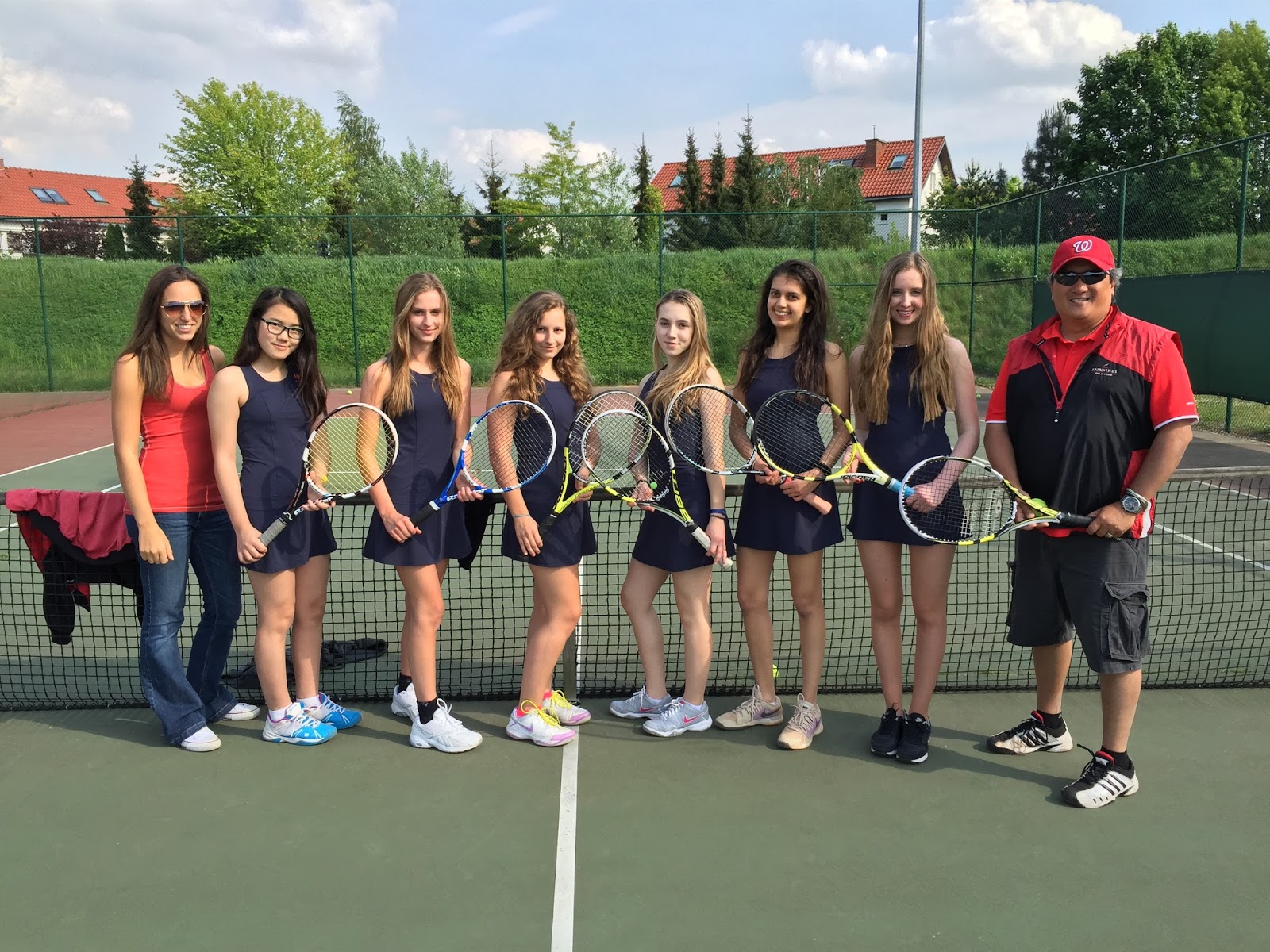
ASW Varsity Girls Tennis Team 2015 - they wanted tennis dresses to look like a team, so we got them!

Fast forward to the end of the season and the CEESA HS Girls Tennis Tournament which we hosted here in Warsaw.  We had students, parents, teachers, and even some Board members and the new Director drop by to watch some tennis and see how it was going.  I think this was significant as we hosted the tournament off campus at a private tennis club, so people had to trek across town to see them play.  And they played fantastically, winning 3 of the 4 individual events plus taking the CEESA Team Championship for the first time in 6 years.  

Now, you might think that getting tennis dresses for the girls is insignificant but it wasn't - it was huge!  The other coaches and players at the tournament all commented on how great they looked on the first day.  My girls were all talking about how they felt like a team for the first time in years - it was all about the dresses (BTW - no other teams were wearing tennis dresses or even proper women's tennis clothing, and some coaches lamented that they could never get their girls into dresses, let alone skirts - we had a new outfit for day 2 ;-).  

CEESA Varsity Girls Tennis Champions 2015 - sporting their day 2 attire of hot pink tops with black skirts!

When the tournament was over and we were wrapping up the season, the girls talked about a number of things which made it very special for them.  I was surprised at what they came up with too.  They were happy about winning the championship of course, but it was all of the other stuff which stuck in their minds.  It was the team spirit that we had cultivated through the practices and out on display at the tournament that stuck with them.  From team warm-ups, to wearing uniforms, to team meetings, to doing team cheers (nobody does that in tennis, but I do), to supporting one another on and off the court.  One of my players even reflected on how "together" we are as a team even though it is a mainly individual sport, which she has never felt before in 5 years of playing on the school tennis team.  The same player also commented on how much she grew and improved this year, both with her skill level but more importantly with the mental part of the game.  What she wrote about was how her mindset changed over the season, and how looking back, it made all of the difference when she was on court at the tournament.

So what did I learn from this, and how does it apply to being a tech coach?  It all has to do with team building.  Building an effective team has to be an intentional process, and the little things count.  Details matter, having common goals and listening to your team is important - done right, this is how you can shift everyone into a Growth Mindset, to bring them together as a group.  Having a growth minded team working together and challenging one another, can lead to great achievements and breakthroughs - sometimes far beyond expectations.  I am really proud of the girls and what they achieved on court, but even more so with how they came together as a team and what they learned about themselves.  One of my players summed it up in her CAS reflection, with something I was constantly saying throughout the tournament - "One point at a time."  She really has taken this to heart, meaning to never give up, learn from your mistakes, and look to the future for the next opportunity . . . all sure signs of the Growth Mindset.

Thursday, June 18, 2015

Coaching with Mindsets in Mind - Part 3

Coaching Lessons Learned . . . on Court

I have been a Tech Coach in title since 2009, but I have been in an integration/mentor/tech PD role in one way or another, for over 20 years.  In my current role as a full time coach I have been studying and reflecting upon cognitive coaching practices, models for tech integration, how to foster innovation and how to affect positive change in a school's culture.  Carol Dweck's research into Mindsets has really hooked me, and has led me to think about my own real life experiences working with and changing students mindset.  A few details in Dweck's book particularly intrigued me, particularly about screening for mindset and being able to put someone into a Growth or Fixed Mindset . . . which got me thinking about if I had personal examples from my own experience.

So let me tell you about some concrete examples and the lessons learned which can be directly applied in the classroom, but which came from a different coaching role . . . as head coach of the Western Academy of Beijing Varsity Badminton Team.


Example #1 

In my first year at WAB, I started a badminton club which met at 7:00 in the morning once a week as that was the only gym time we could get.  We were not a priority at all - some mornings we would arrive and could not use the gym, other mornings we would show up and play without a court or even a net.  At the time, badminton was considered a purely recreational sport within the school, even though it is the national sport of our host country.  But that didn't deter the students who came out to play, who ranged from grades 6-9 - they all just wanted to play and learn.  When the first high school ACAMIS badminton tournament came up in the spring, the club quickly changed into a school team . . . they all wanted to compete . . . even against much older and experienced students!  WAB only went up to G10 that year and my players ranged from G5-9, but we were going to compete against high school teams with players in G9-12 from across China.

So we got organized and started practicing specifically for the different tournament events.  But the rules got changed less than two weeks before the tournament, and we suddenly had to field a mixed doubles pairing.  We hadn't been playing any mixed doubles, so I had to get this figured out quickly.  I took my strongest boys singles player Dom, and then selected a grade 6 girl Hannah, who had a "no fear" attitude and an eagerness to learn, to form our mixed doubles pairing.  I think we only got in three practices with them playing together, learning how to move as a team with the female player controlling the net.  When we went to the tournament, none of the other mixed teams were playing proper mixed doubles style and they could not handle Hannah controlling the net on every point.  Dom was already a very fluid and skilled player, but Hannah had to learn everything about playing mixed style and how to play the net, in a very short period of time.  They dominated the mixed doubles event, were beautiful to watch, went undefeated and were the talk of the tournament.  Nobody could believe that they were in G6 & 9, and had only been playing together for two weeks.

Lesson Learned - Someone with a growth mindset can be moved to do incredible things in a short period of time with hard work, perseverance and a fearless attitude - all signs of a Growth Mindset. And Dweck is right - you can screen people for their mindset to select those who are Growth minded, if you know what to look for.

Hannah is in the back left, and Dom is front and center holding their Mixed Doubles Championship trophy - Go Tigers!

Example #2 

Fast forward a few years to the HS badminton team tryouts.  In walks Mike, a new grade 9 student who has come from a private school in Canada that I know. Mike has a swagger to him, and proceeds to warm up by hitting birds as hard as he could, to show off his prowess and superior skill.  He had been the best badminton player for years at his previous school - nobody could touch him on court because he had too much power.  But I could see a flaw - for all of his power and smooth strokes, he had poor footwork which hampered his game.  I asked him to hit overhead clears from baseline to baseline which he tried to do, but did not have the power.  He had never had to make such a shot before, as nobody else could hit it that deep on him.  But he wasn't in Kansas (or Vancouver) anymore, he was in China!

My approach was simple - I had to first establish a coaching relationship with him in order to break through his shell of bravado.  To jumpstart this process, I appealed to his obvious love of power.  I enticed him with a simple offer/challenge - that I could get him the last 2 meters of distance on his clears in under 5 minutes.  After a moments consideration, he took me up on the challenge.  With some simple coaching on his body positioning and footwork, he started generating more power from his legs and hips.  Pop, pop, pop - he was now hitting the full length of the court.  In about 2 minutes flat, Mike had changed to become a very coachable player and an important part of the team.

Lesson Learned - As Dweck says, you can shift someone from a Fixed to a Growth mindset just by talking to them, and framing things in ways which engages them in learning.  It's all about making connections, building a relationship, and then finding the right hook/challenge/opportunity to draw them in. The moment you have them, is the moment their mindset changed.

China Cup Junior Varsity Championship Team showing off their hardware - Mike is second from the right in the back row

Example #3

What do you get when you put two precocious, bright, MS BFFs on court together?  Either a total disaster or a team with great unrealized potential.  Liz and Monica always wanted to play doubles together since that first year with the club.  At first, they were not complimentary players and were not very good together - all talk and goofing around (after all, they were and still are BFFs).  But over the 5 years playing together they grew stronger as players and teammates, and became my #1 girls doubles pairing.  

One year, we hosted the ACAMIS tournament in Beijing, but finished second to Suzhou - we were close but outclassed in a few areas including girls doubles.  The following year, Liz and Mon lost to the same Suzhou team in the round robin, which bumped them to second place in the girls doubles event.  In the team championships, we were again playing against Suzhou, and girls doubles went so long that it ended up being the deciding match.  Going into that match, Liz and Mon had not ever beaten their rivals.  Rather than delivering a stirring, "let's get pumped up speech" (I'm not that kind of coach), we found a quiet place to talk about their game plan and strategy.  One thing that I love about badminton is that it is a cerebral sport, where you can outwit your opponent and think your way through a match.  

The championship deciding match drew a huge crowd as they were on court for so long. It was full of ups and downs, twists and turns, and changes in the lead.  Suzhou came out strong and won the first game of the best out of three match.  Liz and Mon scrapped and fought to win the second game to tie the match, but fell behind in the third and deciding game.  They dug deep, leaned on each other, clawed to get to a final game tiebreaker, and to eventually win our first of many ACAMIS team championships.  What was I the most proud of? That they thought their way through the match, adapting and changing their game plan as needed to win it in the end.  They talked and communicated on court throughout, and we adjusted to their opponents game during the coaching breaks.

Lesson Learned - Having a growth mindset means learning from your losses, moving forward, and trying again.  Celebrate your failures, don't mourn them.  Learn from them, rather than make excuses.  And having supportive peers around you can make all of the difference.  A growth minded team is much stronger than the sum of its parts, and will take you beyond your setbacks, losses and failures.

That's Liz and Mon on the front-left after our second consecutive ACAMIS Championship - Go Tigers!


It's all about the learning - on the court or in the classroom!  Mindset matters!


Monday, June 15, 2015

Coaching with Mindsets in Mind - Part 2

It's that time of the school year for reflection, which also means surveying the teachers that I work with in order to improve my practise and to better support the faculty in the future.  Over the past few years, I have found the faculty survey process to be enlightening, definitely useful and seriously stressful all at the same time.  As I work primarily with faculty, it is an inherently different process than surveying the students in your class.  I just sent out my tech coach survey and the responses are starting to trickle in - it's a very busy time of year for everyone so I do not expect to get a 100% response rate.  Last year, I received feedback from almost half of the faculty, which I reckon was pretty good.  I have read that with some big schools and universities, that they consider a 1/3 return rate as highly successful.  But I don't think that the previous response rate will be repeated this year, as we have a huge turnover of teachers in the high school - I wonder if the leavers will find the time to do my survey at all, over the myriad of other tasks that must be on their plate right now.

As the first responses come in, I can't help but have a look at the written comments and think about what I can learn from them.  One comment has stuck in my mind (for the last few days ;-) went something like this:
Could you audit a unit in everyone's class and give suggestions about how tech could improve the unit?
Coaching is active and self-reflective, should be initiated by the teacher and focus on the teacher's own pedagogy.
This has really made me think and I have flip-flopped back and forth about whether this suggestion has merit, whether it is very practical or productive, and whether it would even work.  I have gone from "there isn't time to do that", to "how would I choose which unit to audit?", to "this approach could work for some, but not everyone."  To me, there are a number of facets to this suggestion which determine how successful such an approach would be, which include:
  • Evaluation - as a tech coach, my role is strictly non-evaluative which means that I cannot/should not randomly audit a lesson or unit and then present my ideas about how it could be changed or improved; unsolicited feedback generally does not go over well with faculty and can sometimes have the opposite effect where the walls go up and doors close; this approach would only work if I was invited in to observe, initiated by the teacher
  • Time and Practicality - as I work with about 35 faculty members who teach over 100 different courses across the high school, finding the time to audit whole units from everyone's courses seems to be totally impractical; again, having the teacher identify the unit or lesson in advance would be more practical
  • Focus - taking the time to audit a unit of a course without having a specific focus for the observation would not be productive; in order for this approach to be successful, the focus of the observation needs to be identified in advance by the faculty member rather than the coach; furthermore, discussing the focus of the observation in advance would also be important as that could lead to identifying the best lesson or unit to be observed, rather than the other away around
  • Mindset - in order for coaching to be effective, the teacher being coached must have a growth mindset and be willing/wanting to improve/update/change/transform their unit, lesson or project . . . if the teacher has a fixed mindset then any suggestions I have for them will likely be met with resistance and defensiveness; I have experienced this before when a teacher has asked for "general feedback and ideas" but is unwilling to even consider trying any of them due to "not having any time", or they "don't really know if it would work", or "maybe next year when they do this project again".
I recently read Carol Dweck's "Mindset - the New Psychology of Success" and have been reflecting on how people's mindset impacts on my work, and how I can apply her research to working with faculty.  Framing this faculty member's comment in Dweck's work makes me think that this suggestion has some positive elements which can be extracted and used next year.  Dweck says that you can screen for mindset, to look for those who are growth minded.  Applied here, I should not use a "one-size fits all" approach and try to audit a unit from everyone's classes - that just would not work.  Instead, I should make a bigger effort to actively ask faculty to invite me into a lesson or to audit a unit or to plan a project, in order to find the growth minded.  I do this already, but perhaps this person never took me up on the offer.  Perhaps being more forward with this and providing a little more encouragement would tip the scales for this person and for others as well.  By screening for mindset, I would also be able to identify the units/lessons/projects that the faculty member wants to work on and focus on the specific aspects that they want to improve upon.  

With respect to educational technology, do you have a Fixed or Growth Mindset?
Are you set in your pedagogy, constantly recycling lessons and units from one year to the next?
Dweck also talks about putting someone into a Growth Mindset, just by talking with them.  Growth minded teachers are reflective and are looking to improve their pedagogy/approach/delivery, rather than passively waiting for someone to tell them what and where to improve.  Waiting for someone to tell you what to do is a clear sign of a Fixed Mindset which made me think at first that this comment was coming from such a faculty member.  On further reflection and application of Dweck's ideas, I think this person could be in the middle of the continuum between Growth Minded and Fixed Minded, and just needs a little nudge to get to across the fence.  For the teacher who is open to me auditing a unit or lesson in their class, but does not have a focal point in mind already, perhaps they can be moved into a Growth Mindset simply through a professional planning conversation.

So my takeaways from this comment are to give some more nudges and opportunities to the faculty, which I can easily do when I touch-base with everyone on my regular Walkthroughs.  When I check-in with them I will now extend my initial ask "Is there a lesson/unit/project that you would like my help to plan" to include "or which you would like me to sit in on to give you feedforward and ideas?"  I think this added nudge will help to engage some of the faculty who don't want to take the time or risk to plan a lesson/unit/project with me, but are willing to invite me into a lesson(s) where they choose what they want me to focus on for collecting data and providing feedforward (note that I purposefully use feedforward here based on this article by Joe Hirsch for Edutopia which explains how feedforward is looking for positive change in the future).  It will also help me to screen for the Growth Minded teachers who just need a little encouragement to take the next step forward with tech coaching to improve their teaching practice.  Even small steps forward will eventually get you to where you are going in the end!